


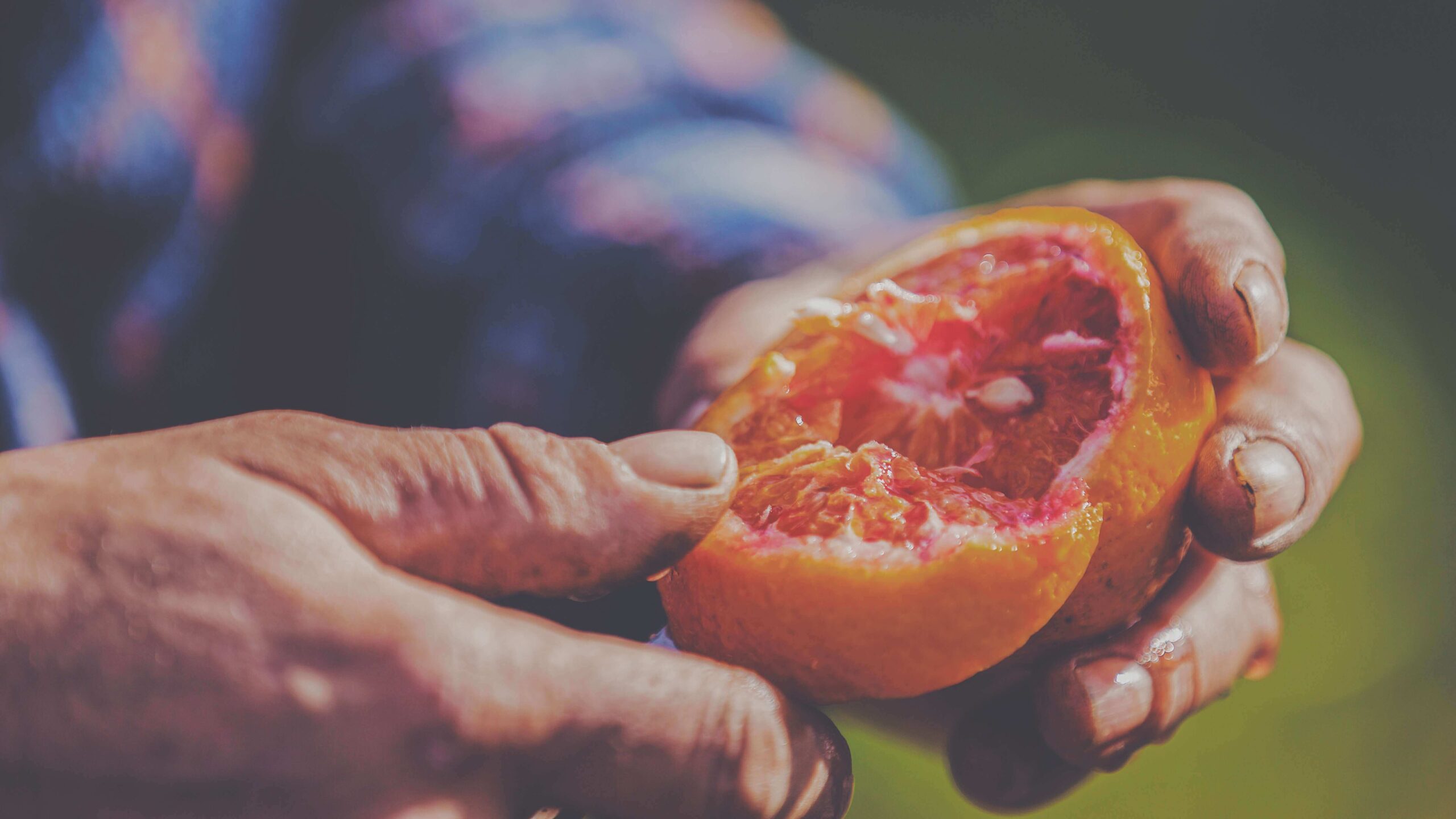
The name Sicilian Blood Orange (PGI) is used to identify certain orange varieties with Protected Geographical Indication (PGI) grown in numerous towns in the provinces of Catania, Enna and Siracusa.
The PGI designation recognises the following varieties as Sicilian blood oranges:
- the Tarocco variety, with the clones: Tarocco Comune, Tarocco Galice, Tarocco Gallo, Tarocco Messina, Tarocco dal Muso, Tarocco Nucellare 57-IE-1, Tarocco Nucellare 61-1E-4, Tarocco Catania, Tarocco Scirè, Tarocco Rosso;
- the Moro variety, with the following varieties and clones: Moro Comune, Moro Nucellare 58-8D-l;
- the Sanguinello variety, with the varieties and clones: Sanguinello Comune, Sanguinello Moscato, Sanguinello Moscato Nucellare 49-5-3, Sanguinello Moscato Nucellare 49-5-5, Sanguinello Moscato Cuscunà.
The oranges have a peel that is bright green with red shading that varies depending on the variety and the harvest period.
The production specification for the Protected Geographical Indication “Sicilian Blood Orange” is governed by a Circular of the Ministry of Agricultural Policies – GURI No. 240 of 14 October 1997, which provided for the entry in the “Register of Protected Designations of Origin and Protected Geographical Indications” pursuant to EC Regulation No. 1107/96.
The Protected Geographical Indication (PGI) “Sicilian Blood Orange” is reserved for pigmented fruit. PGI (Protected Geographical Indication) is a quality mark awarded to a product whose origin takes place in a specific geographical area. Producers who use the PGI must therefore comply with the strict rules set out in the production specification, and compliance with these rules is ensured by the control body. The production area of Sicilian Blood Orange includes the municipalities of eastern Sicily that are suitable for cultivation.
